I investigate how a community’s structure shapes its epistemic capacities.
I use formal models to study how features of a community, such as consensus, disagreement, reliability, and resilience, emerge from how its members interact and from the structures those interactions build. I look at how seemingly irrational behavior by individuals can combine to make the group as a whole rational, and how individuals who increase their own expected accuracy can decrease their community’s by doing so. I apply these results to scientific communities and to public discourse shaped by social media and AI.
The projects fit into a larger picture of feedback between a community and the institutions through which it inquires. Journals, review norms, platforms, and AI systems shape the options open to members. The choices members make produce collective dynamics, and those dynamics reshape the institutions in turn.
I treat AI as an institution of this kind. Instead of modeling AI as an agent, I model it by changes to the structure of an epistemic environment.
- Mereological conflictIn preparationChoices that raise each member’s expected accuracy can lower the community’s.
- Wise cascadesComplex Networks 2026How far members defer to their peers decides how reliable the community’s cascades are.
- The conservation of evidential varianceIn preparationWho pools evidence with whom decides where the variance in that evidence shows up.
- Modal and social varianceFEW 2026, NeurIPS 2026 workshopOverlap in members’ evidence trades disagreement for unpredictability.
- Selective sharingFEW 2020Sharing only the evidence one thinks will help can leave a community failing together or split into entrenched camps.
- Human–AI inquiryNext projectRecommending systems adapt to how a community uses them, closing the loop.
Mereological conflict
Paper in preparation
The modal and social variance result and the wise cascades result are both instances of a class of problems I call mereological conflicts, in which every member of a community can raise their own expected accuracy by doing what lowers the community’s. Suppose each of seven members can either rely on a source with accuracy 0.7 whose errors are independent of everyone else’s, or share a single source with accuracy 0.75, such as a common dataset or an AI system that many people consult. Each member does better with the shared source. The probability that a majority is correct falls from 0.87 to 0.75, because shared evidence means shared failures.
These conflicts differ from familiar collective action problems. In a tragedy of the commons, individuals gain at one another’s expense. Here no member gains at another’s expense, and the community is nothing over and above its members, yet each member can expect to do better while the community expects to do worse. The conflict lives in modal space, in what each member and the community can expect across possible outcomes, rather than in any single run. Because it requires neither irrational nor self-interested members, it can explain collective epistemic failures that would otherwise be attributed to one or the other.
Forty possible worlds, one per column. Each row is a member, and the bottom row is the community’s majority vote. Worlds are ordered so that the shared source’s failures fall on the right.
Move members to the shared source one at a time. Each switch raises that member’s accuracy, while their red cells line up in the same worlds and the majority’s accuracy falls.
- Average member accuracy
- Chance the majority is correct
Wise cascades
Complex Networks 2026, Granada, December 2026Full paper in preparation
Information cascades, in which people set aside their own evidence and defer to those before them, are usually treated as a failure of rationality, and the wisdom of crowds as a success. I add a single parameter τ to the canonical cascade model, governing how much weight agents give to their peers’ votes. At τ = 0 the model is the wisdom of crowds model, and at τ = 1 it is the cascade model. The parameter can be read as a community’s trust in its members’ judgments, or as its evidential standard for when to stop inquiring and defer.
At intermediate values a community still enters a cascade, though only after a longer run of independent votes, and the cascade it enters is far more likely to be right. The wise cascades theorem says that for any desired level of reliability, some τ and population size guarantee a cascade correct to that level. A community can acquire reliable authority that none of its members has, and past a certain point its members can ignore their own evidence without epistemic detriment.
The extension I am presenting at Complex Networks runs many parallel lanes of agents that sometimes communicate, so that cascades can form locally while remaining defeasible globally.
Fifty-one people vote in turn on a yes-or-no question. Each gets a private signal that is right with the probability set below and sees every earlier vote. Once one answer leads by d* votes, the weight on the crowd outweighs any private signal and everyone after follows.
Slide τ up from 0. The band narrows, so cascades start sooner and are wrong more often. On the curves below, the majority never does better than at τ = 0, while the average member does best somewhere in between.
- Lead that starts a cascade, d*
- Chance a cascade is correct
- Average member accuracy
- Chance the majority is correct
Computed exactly across the whole range of τ.
The conservation of evidential variance
Paper in preparation
The modal and social trade-off is one case of a more general decomposition. The variance of the evidence a community gathers divides into three parts. Individual variance is the spread among the samples within a single member’s evidence. Social variance is the spread between members. Modal variance is the spread between the community’s possible aggregate outcomes.
EV = IV + SV + MV
The total is fixed by the random variable being studied. How much each member tests, and whose results each member pools with their own, decide where the variance sits. The identity holds however the members go on to process their evidence.
Twelve members on a ring run trials of a coin that lands heads 60% of the time and pool their results with their neighbors. Each circle shows a member’s pooled estimate in one run. The bar splits the variance of all pooled evidence across 400 simulated runs.
- Individual variance
- Social variance
- Modal variance
- Evidential variance
Add neighbors and watch the estimates on the ring converge as social variance turns into individual variance. Add trials per member and both social and modal variance shrink. The total never moves.
Modal and social variance
Presented at the Formal Epistemology Workshop, 2026Application to populations of LLM agents at a NeurIPS 2026 workshopUnder review
Evidence produced by a probabilistic process varies from sample to sample, and judgments formed from that evidence inherit the variation. The variance divides into social variance, the disagreement among a community’s members, and modal variance, the unpredictability of where the community as a whole ends up. The split follows from the law of total variance, and the trade-off between modal and social variance depends on the degree of overlap between the members’ evidence. Greater overlap makes members more alike and makes the community’s outcome less predictable.
This gives one account of why diversity in evidence is valuable to a community.
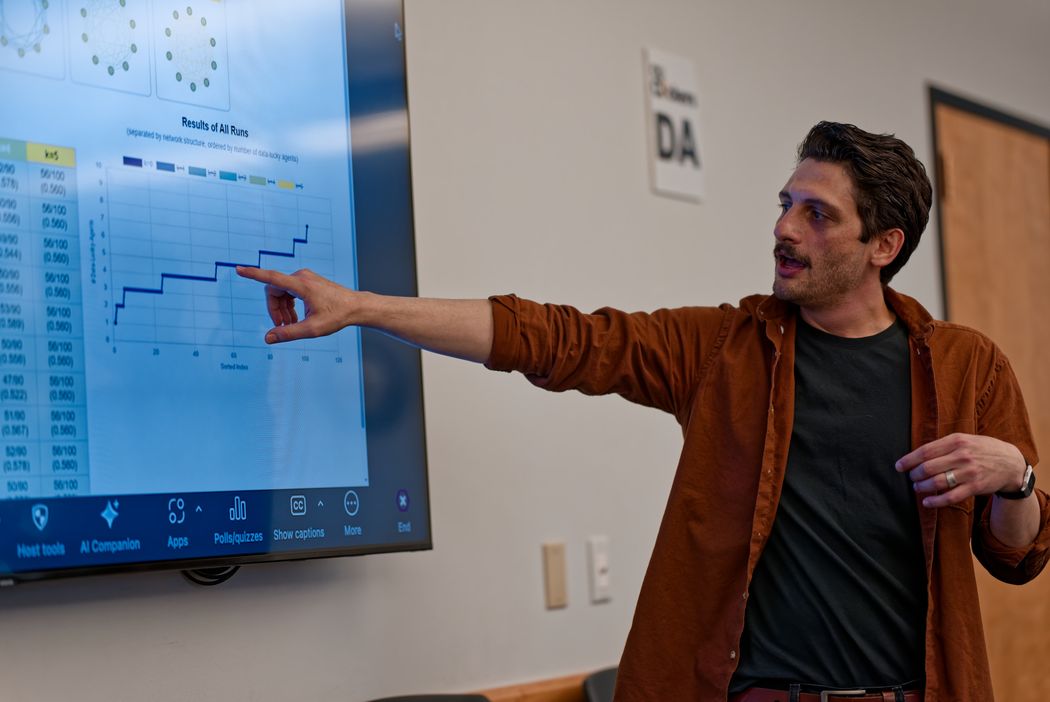
In each of 200 possible worlds, ten members hold 21 samples each from a coin that lands heads 55% of the time, so the community's evidence and each member's share of it stay fixed. Members then trade samples, heads for tails, so that their holdings become more similar or more different. Each member judges that heads is more likely when most of its samples are heads. The line shows the fraction of members who judge correctly in each world, with the worlds sorted from worst to best.
Trade toward similar evidence and the line tilts toward vertical, as more worlds end with every member right or every member wrong. Trade toward different evidence and it flattens. The evidence bar shows variance moving only between individual and social. The judgment bar shows it moving between social and modal.
Both bars are drawn to the same scale, where a full bar is 0.25, the largest variance a yes-or-no quantity can have.
Selective sharing
Presented at the Formal Epistemology Workshop, 2020Developed in my dissertation
A community can polarize without anyone lying. If agents share only the evidence they believe will improve their peers’ accuracy, the community can form echo chambers that end in entrenchment or group-think, and these echo chambers form even when no one is cut off from opposing views.
Every result a selective agent reports is real. The record they leave behind can still mislead as badly as fabricated data, which gives a way to model bias without any dishonest agent. I plan to return to this work with the variance framework, asking how sharing strategies interact with the structure of a community’s evidence.
Twelve labs sit on a ring and test a new treatment B against a standard treatment that works half the time. B actually works 45% of the time, so the right conclusion is that B is worse. Each round, every lab runs ten trials and updates on its own results and, at half weight, on what its neighbors report. A selective lab reports a batch only when it currently believes B is better and the batch agrees. Selective labs are spread evenly around the ring.
This is the trade between social and modal variance from above, pushed to extremes. With sparse connections, labs split into camps that entrench on opposite answers, which is social variance. Raise the connectivity and group-think becomes more likely; when the community fails together in some runs and not others, that is modal variance. Selective sharing has little effect until most labs do it.
- Runs where every lab ends up right
- Runs that split into camps
- Runs where every lab ends up wrong
One run, with the labs in ring order:
- Labs in this run that end up believing B is better
- Gap between what was reported and what was observed
- Equivalent fabrication
Human–AI inquiry and the topology of epistemic dependence
Next project, in development
This project extends the fabric of the cascade model to communities that rely on AI. No single AI system observes the whole community. Different parts of an information infrastructure adjust to local behavior: frequently consulted sources become easier to find, neglected sources become harder to discover, and some questions become easier to pursue than others.
I model this as an adaptive network in which agents keep their private evidence, their reliability, and their willingness to defer, while the systems that recommend sources to them update according to how those recommendations are used. The question is how the resulting dynamics shape a community’s resilience, its capacity to withstand misleading evidence, and its plasticity, its capacity to revise its beliefs when new evidence arrives.
Here the institution is the part of the loop that adapts. The recommending systems change the options open to members, the members’ use of those options produces collective dynamics, and the dynamics feed back into what the systems recommend next.
The variance result says what to look for. As a community’s informational routes narrow, variance shifts from disagreement among members to unpredictability in the community’s outcome, so a community can grow more uniform while becoming more likely to fail together.
Dissertation
From Evidence to Opinions: Exploring Variance in Scientific Communities
Ph.D., Texas A&M University, 2023
Much of this work began as questions in my dissertation, which studied networks of scientists who each produce their own statistical research and share it with those they are connected to. Its models vary network structure along with strategies for sharing, trusting, and updating, and its explanations of polarization and group-think rest on the nature of statistical data and how it is distributed, whether or not the agents themselves are rational.